
A dish does not need to be dropped to break. Plates crack when they are packed flat, wrapped in too little paper, or left with an inch of empty space that lets them rattle for the whole drive. A dish box that survives the truck has three things going for it: a padded base, pieces that cannot touch each other, and no room for anything to shift.
This guide walks through how to pack dishes for moving in the order a trained packer works: the right supplies, plates, bowls, glasses and stemware, mugs, platters, labeling, a simple test before you seal the box, and how to unpack without losing a saucer in the paper pile.
The Supplies That Actually Protect Dishes
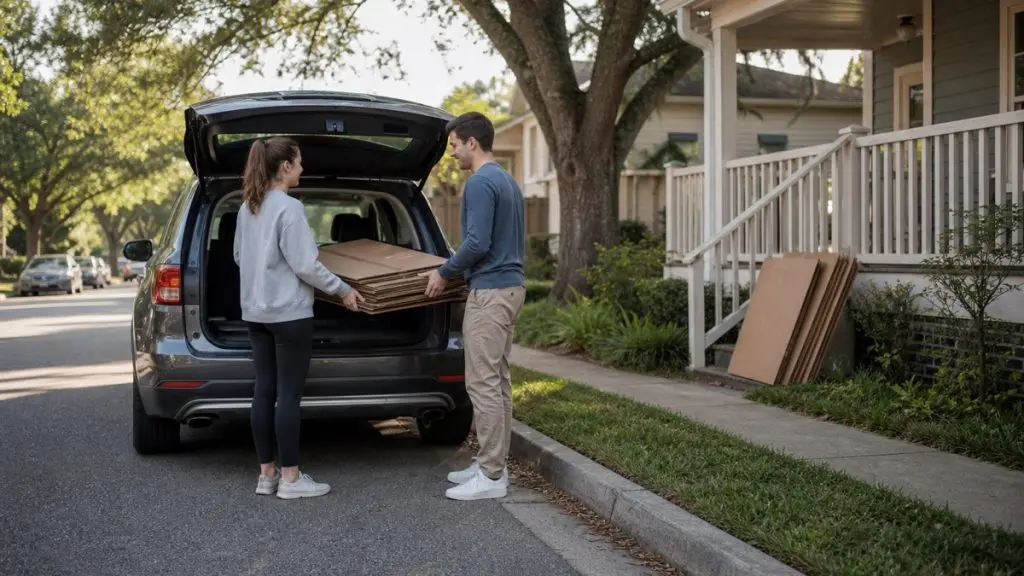
Start with the box. A double wall dish pack, often sold as a dish barrel, is the standard carton for kitchenware. A typical one measures 18 by 18 by 28 inches with a 51 ECT double wall rating, which means the walls resist crushing when other boxes are stacked on top. If you cannot get dish packs, use small, sturdy boxes that have never been wet or reused several times. A small box forces you to keep weight down, and that matters more than extra capacity.
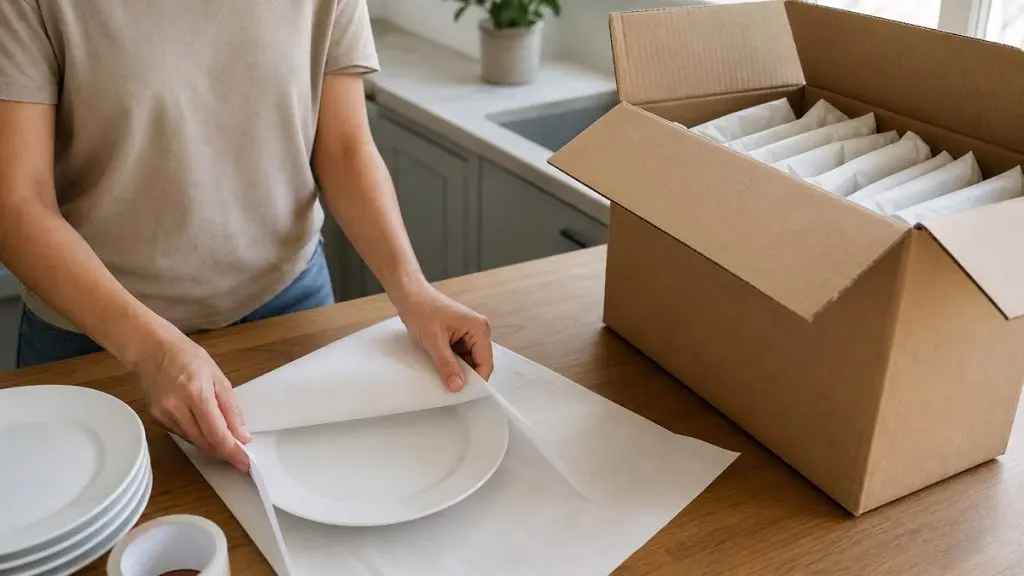
Paper is the second decision. Use plain, unprinted packing paper, not newspaper. Newsprint ink rubs off onto glazes and unglazed rims, and you end up washing every piece at the new house. Retail packing paper usually comes in sheets of about 24 by 30 inches that are ink free and acid free, which is large enough to wrap a dinner plate with room to fold.
For glassware, add a set of cell dividers. These cardboard grids turn one box into dozens of separate compartments. One common kit for a dish barrel has two upper layers of cells about 4.25 inches square and 6.5 inches deep, plus a bottom layer of 3.25 inch cells that are 12 inches deep. Those tall bottom cells are where stemware belongs.
Finish the kit with strong packing tape, a thick marker, and bubble wrap for heirloom china or anything with gold trim or thin handles. Plan on more paper than seems reasonable. Running out halfway through the china cabinet is how people end up cutting corners.
How To Pack Dishes For Moving Step By Step
Clear a table, set up a stack of paper, and work one category at a time: plates, then bowls, then everything else. Here is how to pack dishes for moving so the box holds up to lifting, stacking, and the vibration of the ride.
- Tape the bottom twice. Run tape along the center seam and then across both edge seams. Dishes are dense, and a weak bottom is the fastest way to lose a full box.
- Build a padded base. Crumple several sheets of paper into loose balls and press them into a layer at least 3 inches deep across the bottom. This layer absorbs the shock when the box is set down hard.
- Wrap every plate individually. Lay a plate in the center of two or three sheets, fold a corner over it, rotate the plate, and fold the next corner until it is fully covered. Tuck the last corner and tape only if the paper will not stay closed.
- Bundle plates of the same size. Stack three or four wrapped plates and wrap the stack in another sheet. Similar sizes support each other evenly; mixing a dinner plate with a saucer creates pressure points.
- Stand the bundles on edge. Place plate bundles upright in the box, like records in a crate, never flat. A plate on edge takes a bump along its rim, while a flat stack absorbs every jolt across the center of the bottom plate.
- Nest bowls with paper between them. Wrap each bowl, then nest two or three of the same size with a crumpled sheet inside each one. Set them on their rims or on their sides in the layer above the plates.
- Fill every void. Push crumpled paper into gaps along the sides and between bundles until nothing moves. Empty space lets pieces knock together, and that is what breaks them.
- Cap the box. Add a final layer of crumpled paper so the flaps close flat without bulging or sinking, then tape the top shut.
- Label three sides and the top. Write FRAGILE, THIS SIDE UP with arrows, the room, and the contents, such as “Kitchen, everyday plates and bowls.”
Put the heaviest pieces on the bottom layer and lighter items above them. A dish barrel may carry a gross weight rating of 120 pounds, but that is the carton’s limit, not a target. Stop filling when the box is still comfortable for one person to lift with good form, and start another box.
How To Pack Glasses, Stemware and Mugs
Glasses fail in a different way than plates. The rim and the stem are the weak points, and a glass that is empty inside can crack under outside pressure. The core of how to pack glasses for moving is simple: support the inside, protect the rim, and keep every glass in its own cell.
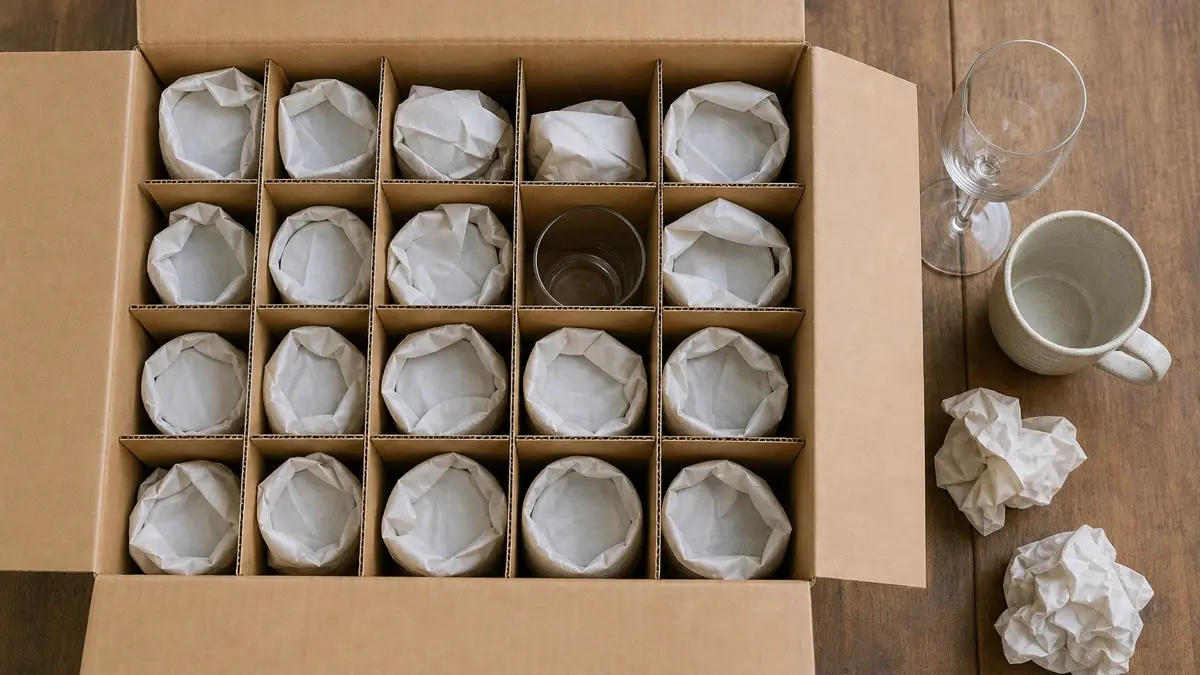
For tumblers, stuff a loose ball of paper into the glass first. Then roll the glass across a sheet at an angle, folding the paper into the opening at each end. Place tumblers rim down or upright in the upper cells, one per cell, with a little crumpled paper on top so they cannot bounce.
Stemware needs more care. Wrap a narrow strip of paper around the stem until it is as thick as the base, then stuff the bowl and wrap the whole glass. Stand wine glasses and champagne flutes in the tall bottom cells, which is why that deep layer sits at the bottom of the box. For crystal or glasses you cannot replace, add a layer of bubble wrap over the paper.
Mugs break at the handle. Wrap a small strip of paper around the handle before wrapping the body, which pads the one piece that sticks out. Mugs can go in cells or be packed upright in a small box with paper between each one.
Platters, Serving Pieces and Odd Shapes
Large platters and serving trays do best standing on edge along the long side of a dish pack, wrapped individually with extra paper on the rim. If a platter is wider than the box, it needs a flat picture box or its own carton padded on all sides.
Covered casseroles, teapots, and gravy boats have loose lids. Wrap each lid separately, set a sheet of crumpled paper inside the base, and pack the pair next to each other so they stay together at unpacking. Pitchers and vases should be stuffed and wrapped like glasses, then set upright.
Items stored in a china hutch or sideboard need to come out before the furniture moves. Move Gurus lists breakable items among the things that cannot be left in drawers in its moving FAQs, because a drawer offers no padding and no control over shifting. For the rest of the kitchen, including pots, pantry items, and small appliances, see our guide to packing kitchen items properly for a move.
How To Test a Packed Dish Box Before You Seal It
Close the flaps without taping, grip the box by the handholds, and lift it a few inches. Tilt it gently one way and then the other. If you hear clinking, feel anything slide, or notice the flaps sinking, open the box and add paper where the movement came from.
A good box feels solid and quiet, like one heavy object instead of a collection of pieces. Run the test on every dish box, not just the first few. The last boxes of a long packing day are the ones most likely to be underfilled.
Mistakes That Break Dishes During a Move
Packing plates flat is the classic error. Using newspaper is another, which smudges and is thinner than packing paper. Overloading large boxes is another. A big box full of dishes is hard to carry, easy to drop, and more likely to split at the bottom.
Towels and clothing can fill gaps, but they compress over time and do not hold pieces apart the way crumpled paper does. They work as top padding, not as the main wrap. Reused grocery boxes are also a gamble, since the walls may already be soft from moisture or earlier use.
The quieter mistake is skipping labels. Unmarked dish boxes get stacked under heavier cartons or loaded on their sides, and no amount of wrapping protects a box that is carried upside down.
Unpacking Dishes Without Losing a Piece
Unpack over a table or a padded surface, not the floor. Open the box with a shallow cut along the tape so the blade does not reach anything inside. Remove the top paper, then take items out one at a time from the top layer down.
Unwrap every ball of paper before you throw it away. Saucers, small lids, and espresso cups hide easily in a pile of crumpled sheets. Check each piece for chips as it comes out, and keep a note of anything damaged before the paper and boxes leave the house.
When Trained Packers Should Handle Your Dishes
Dishes are light for their value, and that matters for coverage. Move Gurus is responsible for not more than the standard mover’s liability of 60 cents per pound for damaged or missing items, as stated in the company FAQs. Under that standard, a 2 pound serving platter is valued at $1.20 regardless of what it cost. Careful packing, or asking about extra protection before moving day, is what protects fine china and crystal. Read the terms that apply to your move and ask questions before you sign.
If your kitchen holds wedding china, crystal stemware, or a full hutch of serving pieces, professional packing services from Move Gurus put trained packers on the job who are experienced with fine china and glassware and use packing paper, bubble wrap, foam padding, and custom crating when a piece needs it. Our family owned team serves Alabaster, Calera, Sylacauga, Auburn, Florence, and the greater Birmingham area. Request a packing quote from Move Gurus and let us pack the kitchen while you handle the rest of the move.